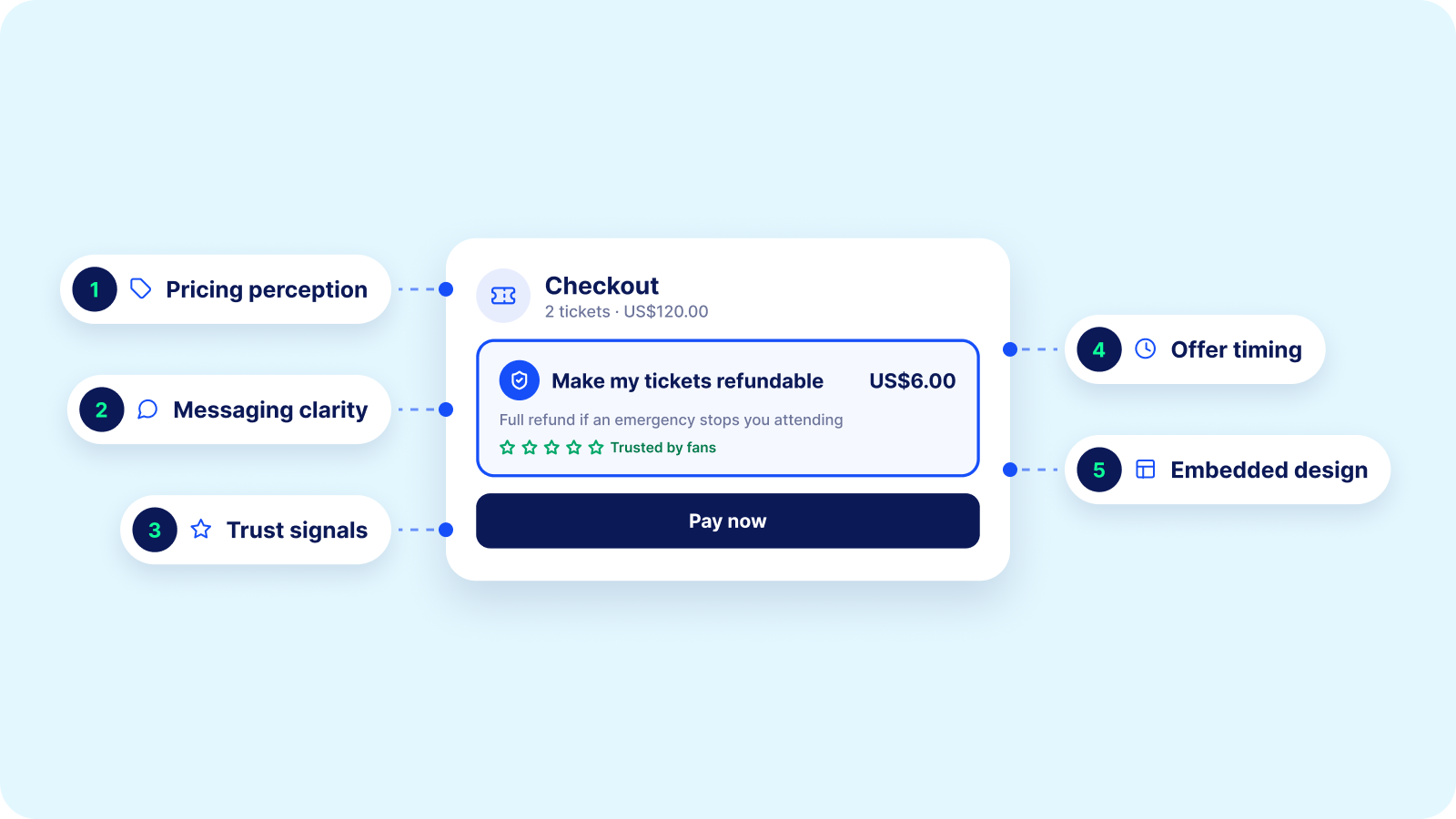


Optional ticket protection is one of the most commercially promising add-ons in event ticketing and travel. Yet opt-in rates remain stubbornly low across the industry. Fans and travellers bypass the offer at checkout, organisers miss ancillary revenue, and the root causes tend to sit on the platform side rather than with the buyer.
For product managers running ticketing or travel booking flows, the problem compounds quickly. Every declined ticket protection offer represents lost revenue and a missed chance to reduce chargebacks, refund disputes, and post-event support volume. This guide breaks down why uptake stays low and shows you how to fix it without adding unnecessary steps to your checkout.
The sections below move from diagnosis to resolution, covering pricing perception, messaging clarity, trust signals, offer timing, and embedded protection design. Each factor shapes whether a customer opts in or scrolls past.
Key Takeaways: Ticket Protection Uptake at Checkout
- Low ticket protection uptake typically stems from unclear messaging, poor checkout placement, and a trust gap between buyer and provider.
- Pricing that appears arbitrary or disproportionate to ticket value creates hesitation, even when the absolute cost is modest.
- Protect Group addresses these barriers through AI-driven smart pricing and embedded checkout positioning via its Pulse platform.
- Offer timing within the purchase flow directly affects opt-in rates, with mid-checkout placement outperforming end-of-flow prompts.
- Transparent refund terms and fast payout timelines are the strongest trust signals for converting sceptical buyers into protection adopters.
What Drives Low Ticket Protection Uptake at Checkout?
Ticket protection uptake is shaped by a combination of factors that interact at the moment a fan reaches the payment stage. When uptake is low, the cause is rarely a single issue. It is usually a compounding effect where weak messaging, unclear pricing, and absent trust signals converge to suppress the opt-in decision.
According to a Koji customer research study, 83% of users on a ticket marketplace did not notice buyer protection information during checkout, and 67% cited trust as a reason for hesitation. That gap between availability and visibility is where most uptake problems begin.
The commercial implication is direct. If the majority of your buyers cannot see the protection offer clearly, opt-in rates will reflect that blind spot regardless of how competitive your pricing or protection terms are.
How Does Pricing Perception Suppress Opt-In Rates?
Pricing is frequently assumed to be the primary barrier to protection uptake. The reality is more nuanced.
A 2025 study published in the Journal of Marketing Research by Reiner, Wamsler, Bornemann, and Natter found that the price of optional protection acts as a risk signal. When the fee appears high relative to the purchase, buyers interpret it as an indicator that something is likely to go wrong, which paradoxically increases anxiety.
For ticketing platforms, this creates a structural challenge. A flat fee that feels reasonable on a high-value concert ticket can feel disproportionate on a lower-priced event. Static pricing models struggle to account for this variation across your ticket inventory.
Pricing resolves this tension. When the protection fee adjusts based on ticket value, event type, and booking timing, the offer feels proportionate to the purchase. Protect Group's Pulse platform applies AI-driven Smart Pricing to calibrate the fee for each transaction, which helps the offer feel like a natural part of the purchase rather than an arbitrary add-on.
Why Does Messaging Clarity Matter More Than You Expect?
Weak checkout copy is one of the most fixable causes of low uptake. When the protection offer uses vague labels or generic language, buyers treat it as an upsell rather than a safeguard.
A label that reads "Ticket Protection" without further context leaves the buyer to fill in the blanks. Buyers typically fill those blanks in the least generous way.
Effective messaging answers three questions in a single line: what is protected, what happens if something goes wrong, and whether the fee is optional. This level of specificity matters because the buyer is making a split-second decision at a high-pressure point in the purchase flow.
Consider the difference. "Add protection" tells the buyer nothing. "Get a full refund if illness, injury, or an emergency stops you attending" tells them exactly what they gain. That specificity converts because it replaces ambiguity with a clear promise.
Platforms that test their checkout copy against different audience segments consistently find that plain-language descriptions of protection outperform generic labels. The goal is to describe the outcome, not the product category.
How Do Trust Signals Affect the Protection Decision?
Trust is the currency of checkout conversions. According to the BTNG Studio research on checkout trust signals, the concerns that drive abandonment are mostly about cost transparency, effort, and timing rather than security fears.
Buyers who hesitate over a protection offer are not thinking about data theft. They are thinking about whether the promise will be honoured if they need to apply for a refund.
Three trust signals consistently move the needle for refund protection offers. First, a visible refund policy near the payment button that explains what happens after a refund application. Second, social proof tied to the transaction experience, such as a Trustpilot rating or aggregate customer count.
Third, named attribution of who handles the refund, which replaces the anonymous add-on with an identifiable partner.
Protect Group carries a 4.8 out of 5 Trustpilot rating from over 35,000 customer reviews. When that credibility is surfaced within the checkout flow, it closes the trust gap that generic protection labels leave open.
Where Should You Position the Protection Offer in the Checkout Flow?
Offer placement within the purchase flow has a measurable effect on opt-in rates. The conventional approach places protection at the very end of checkout, alongside final totals. By that point, the buyer is focused on completing the transaction, and any new decision feels like an obstacle.
Mid-checkout placement, where the protection offer appears after ticket selection but before the payment step, gives the buyer more cognitive space to evaluate the offer. It also frames protection as part of the booking configuration rather than an afterthought bolted onto the final total.
For your own flow, the principle is straightforward. Present the offer at a moment when the buyer is still making configuration decisions, not when they are already reaching for the payment button.
What Role Does Embedded Protection Design Play?
The distinction between bolt-on and embedded protection matters commercially. A bolt-on model treats protection as a separate product that sits alongside the transaction. An embedded model integrates the protection offer into the booking experience itself, so the buyer encounters it as a natural part of configuring their purchase.
Embedded protection design removes the burden of a separate decision. Instead of asking buyers to evaluate a standalone product at checkout, you present a simple upgrade to their existing booking. That reframing changes the psychology of the decision from "do I want to buy something extra" to "do I want to make my ticket refundable."
Protect Group's approach uses a single booking widget that integrates directly into your existing checkout flow. The widget adapts its content, pricing, and positioning based on the booking context, which means you do not need to manage a separate product catalogue or build custom checkout logic to offer protection.
How Does the Traveller Journey Affect Protection Uptake?
What a customer values at the moment of booking is different from what they value on the day of the event. During the anticipation phase, when the booking is new and the event feels distant, buyers are evaluating risk. They are weighing whether to commit their money against the possibility that plans might change.
This is the phase where protection has the highest perceived value, because the buyer is actively thinking about uncertainty. If your checkout surfaces the protection offer with clear language about protected scenarios during this anticipation window, opt-in rates reflect that alignment.
The challenge is that many platforms wait until the buyer has mentally committed to the purchase before introducing the protection option. By then, the risk evaluation is complete and the buyer has already accepted the downside. Late presentation misses the window where protection feels most relevant.
Protect Group's ticketing solutions are designed around this journey-stage logic, presenting the offer at the point where the buyer is still weighing commitment against uncertainty.
What Can You Learn from Platforms That Improved Their Uptake?
Nuweb Group, an event technology partner, integrated Protect Group's Refund Protect into its platform and achieved an opt-in rate where more than one in three fans chose ticket protection. That result came from embedding the offer directly into the platform checkout, using clear language about the protection offered, and surfacing the refund terms before the payment step.
Similarly, Boletia, a Latin American ticketing platform, ran a series of A/B tests on its checkout protection offer and increased Refund Protect conversion by 180%. The gains came from iterating on copy, placement, and pricing calibration rather than from fundamentally changing the product.
The pattern across these examples is consistent. Uptake improves when the offer is embedded, the language is specific, and the pricing feels proportionate to the booking value.
How to Diagnose Low Protection Uptake in Your Own Checkout
Start by auditing what your buyers actually see. Load your own checkout as a first-time buyer and ask whether you can answer three questions within two seconds: what's included in the terms, what happens if you need a refund, and how much does it cost relative to the ticket.
If any of those answers require scrolling, clicking, or guessing, you have found your first barrier.
Next, review your support and dispute history. If buyers regularly ask questions like "would you refund me anyway" or "is this protected by my card," those patterns reveal assumptions that your checkout copy is not addressing.
Each of those questions represents a buyer who declined protection because they believed an alternative already existed.
Finally, segment your opt-in data by ticket price band. If uptake drops sharply for lower-priced tickets, your pricing model may be creating disproportionate perception at the low end. Smart Pricing that adjusts the fee relative to ticket value can correct this without manual intervention.
Step-by-Step Guide to Improving Ticket Protection Uptake
Step 1: Audit Your Current Checkout Copy
Read every word your buyer sees alongside the protection offer. Replace vague labels with specific descriptions. State the protected scenarios, the refund outcome, and the fact that the fee is optional in plain language.
Step 2: Review Offer Placement
Map the exact point in your checkout flow where the protection offer appears. If it shows up only at the final payment step, test moving it earlier in the flow, ideally after ticket selection and before payment details.
Step 3: Evaluate Your Pricing Model
Compare your protection fee against your ticket price distribution. If you are using a flat fee, check whether it feels disproportionate on lower-value tickets. Consider Smart Pricing that scales the fee relative to ticket value and event type.
Step 4: Add Trust Signals Near the Offer
Surface credible proof points within visual range of the protection option. A Trustpilot rating, a named refund partner, or a one-line explanation of the refund process can close the trust gap that vague labels leave open.
Step 5: Test, Measure, and Iterate
Run A/B tests on one variable at a time. Change the copy, then measure. Change the placement, then measure. Change the price, then measure. Avoid changing multiple variables simultaneously, as the data becomes unreadable.
How Does Non-Refundable Ticket Policy Create the Uptake Opportunity?
Non-refundable ticketing protects your revenue from cancellations, but it also creates buyer hesitation at checkout. The trade-off is structural.
Strict policies hold revenue in place but can suppress advance ticket sales when buyers are uncertain about their plans. Flexible policies encourage earlier purchases but expose you to cancellation-driven revenue loss.
Refundable ticket upgrades resolve this tension by giving the buyer flexibility without changing your base ticketing policy. You keep the non-refundable rate as your default, and the protection upgrade creates a path to refundability that the buyer funds directly. The result is earlier ticket purchases, reduced chargeback risk, and a new ancillary revenue stream that did not exist in the original transaction.
When buyers understand that protection gives them a defined path to a full refund in protected scenarios, the non-refundable policy becomes less of a deterrent and more of a reason to upgrade.
How Protect Group Helps You Increase Ticket Protection Uptake
Protect Group's approach to ticket protection is built around the specific barriers that suppress uptake. The Pulse platform uses AI-driven Smart Pricing to calibrate the protection fee for each transaction, removing the disproportionate pricing problem that flat-fee models create.
The Content Intelligence Platform, a component of Pulse, tests the wording, placement, and design of your protection offer across your audience. It runs continuous optimisation so the checkout experience adapts to what converts, without requiring your product team to manage manual A/B tests.
On the refund side, Protect Group processes every application through its Refund Platform in over 30 languages. REx, the AI review function, approves clear-cut applications automatically, while the Customer Experience team reviews every other case. AI never declines an application, and Protect Group funds every approved refund.
Turning a Passive Checkout Add-On into a Conversion Lever
Low ticket protection uptake is a presentation problem, not a demand problem. The barriers are specific and fixable: vague messaging, static pricing, weak trust signals, and poor offer placement. Each one can be addressed through targeted changes to your checkout flow.
The commercial case for fixing these barriers is direct. Higher uptake means new ancillary revenue on every transaction, fewer chargebacks from non-refundable tickets, and earlier ticket purchases from buyers who feel confident committing. Protect Group's embedded approach, powered by the Pulse platform, is designed to address each of these barriers within your existing booking flow.
Start with a checkout audit. Identify where your buyers lose clarity, trust, or motivation. Then test one change at a time and let the data confirm what your audience responds to.
FAQs About Ticket Protection Uptake at Checkout
What is a good opt-in rate for ticket protection?
Opt-in rates vary by event type, ticket value, and checkout design. Protect Group partners have achieved rates where more than one in three buyers choose protection, which indicates that the right combination of pricing, messaging, and placement can move uptake well beyond industry averages.
Why do buyers decline ticket protection even when it is affordable?
Price is rarely the main objection. Buyers decline because the offer is unclear, the protection feels vague, or they assume the merchant or their card issuer will cover a loss. Clear messaging that describes the specific refund outcome addresses all three objections.
How does Smart Pricing improve ticket protection conversion?
Smart Pricing adjusts the protection fee based on ticket value, event type, and booking timing. Protect Group's Pulse platform applies AI-driven smart pricing so the fee feels proportionate to each purchase, which reduces the perception gap that flat-fee models create on lower-value tickets.
Should ticket protection be pre-selected at checkout?
No. Pre-selecting the offer risks triggering buyer distrust, as consumers associate auto-added fees with deceptive checkout practices. An opt-in model where the buyer actively chooses protection builds more sustainable uptake and fewer post-purchase disputes.
What is the difference between ticket protection and event cancellation cover?
Ticket protection protects the buyer when personal circumstances prevent attendance, such as illness or an emergency. Event cancellation cover applies when the event itself is cancelled by the organiser. Protect Group's Refund Protect focuses on the personal-circumstances side, giving buyers a full refund path when protected situations arise.
How does embedded protection differ from bolt-on add-ons?
Embedded protection integrates the offer directly into the booking flow so it feels like a natural part of the purchase. Bolt-on add-ons present protection as a separate product, which requires an additional buying decision. Protect Group uses a single booking widget that embeds within your existing checkout, reducing the decision burden for the buyer.