%20(1).jpeg)


.svg)


Picture Marcus. He has spent the last three nights planning a long-awaited family vacation on your online travel agency (OTA) platform. He has perfectly synchronised the multi-city flights, selected a highly rated boutique hotel, and confidently clicked "Confirm Booking."
He is in the final stretch. His credit card is resting next to him, ready to finalise the booking.
Then, he encounters the "Trip Cancellation Waiver" step. Instead of a straightforward, reassuring choice, he is greeted by a dense, grey block of 8-point text packed with phrases like: “Coverage is subject to standard exclusions outlined in Section x(y).”
Marcus pauses. His brow furrows. What exactly constitutes an exclusion? If the airline disrupts my flight, am I out the money? Is this platform just trying to sneak an extra fee past me?
The vacation excitement evaporates. His brain enters threat-detection mode. He closes the tab, telling himself he’ll "look into the fine print later."
He never comes back.
For travel, hospitality, and airline merchants, this is the “fine print tax” in action. It is the heavy financial penalty brands pay when they mistake compliance legalese for functional checkout design. When travellers encounter ambiguity at the most financially vulnerable moment of their booking journey, trust plummets, and high-value carts are silently abandoned.
The psychology of the booking drop-off
Travel purchases inherently come with booking anxiety. Unlike buying a pair of shoes, booking a flight or a vacation package means purchasing an experience that happens weeks or months in the future. The customer is exchanging a large sum of money for a promise.
But when a booking flow introduces opaque terms or complex conditions at this critical juncture, it triggers two powerful psychological defence mechanisms:
1. Ambiguity aversion
Rooted deep in behavioural economics, ambiguity aversion dictates that humans would rather choose a known risk over an unknown risk. If a traveller does not explicitly understand what a refund policy or cancellation waiver covers, their brain registers it as a potential trap. To protect themselves, they retreat to the safest possible option: abandoning the checkout.
2. Cognitive overload
By the time a customer reaches your payment page, they have already expended massive mental energy navigating flight times, room types, and calendar dates. Forcing them to suddenly parse a mini-contract re-engages their analytical brain, spiking friction and killing the emotional high of booking a trip.
The reality check: You aren’t just competing against other travel brands; you are competing against the customer’s instinct to protect their wallet from the unknown.
The cost of the transparency deficit
Many travel and hospitality teams treat ancillary options, like travel insurance, refund protection, seat upgrades, or flexible booking options, as secondary line items best managed by legal teams.
The data proves this approach is costing the industry billions.
Data from Statista and VWO reveals that the travel industry suffers from one of the highest cart abandonment rates in digital commerce, sitting at a staggering 82%. When you look closer at the root causes, the issue points directly to a lack of clarity:
- 48% of travellers abandon their bookings due to unexpected costs, hidden fees, or sudden price changes at checkout
- 16% drop out because they cannot easily calculate or understand the total cost breakdown
- According to research by Morning Consult, less than 45% of travellers believe travel providers are transparent about pricing and terms, creating a "transparency deficit" before checkout even begins
When you add these up, a massive slice of your lost booking revenue isn't due to hotel quality or flight times; it’s driven entirely by a lack of clarity.
Moving from defence to optimisation
Condemning old-school, text-heavy booking flows is about more than aesthetics. It’s about building a highly effective conversion strategy. Complete operational transparency acts as an accelerator for travel bookings.
By flipping the script and offering clean, upfront, and clear choices, you transform a moment of doubt into a moment of confidence.
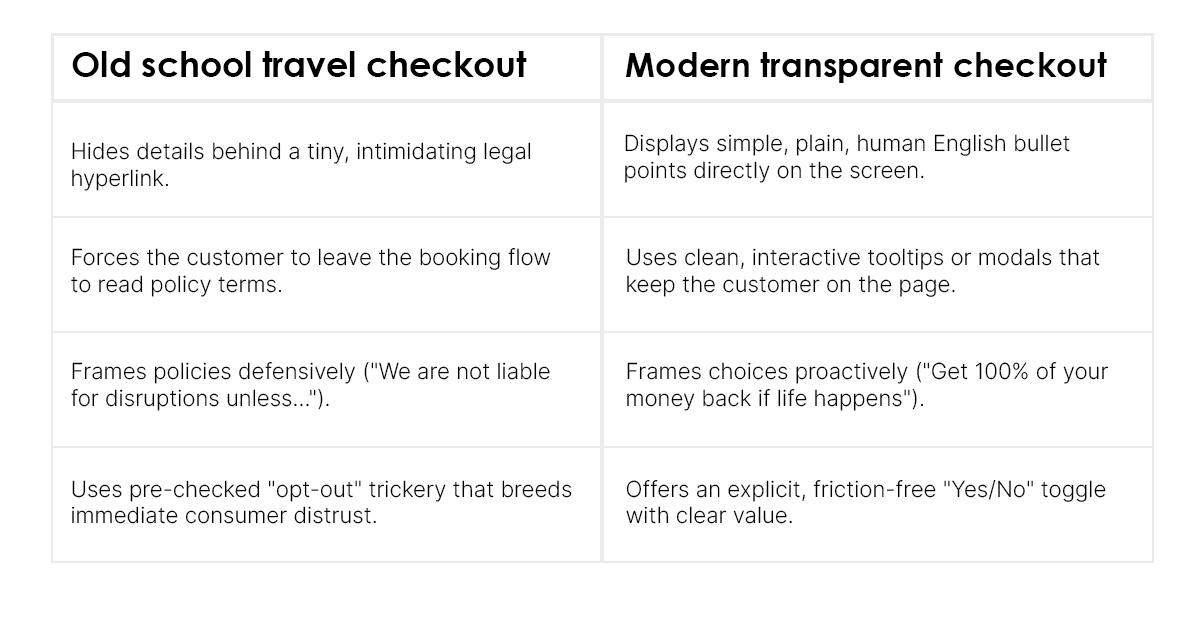
How to abolish the “fine print tax”
If you want to move your baseline conversions from the depths of hidden cart abandonment, you must evaluate your booking flow through the lens of radical clarity and think about the person behind the screen.
1. Speak like a human, not an Underwriter
Review every piece of micro-copy near your payment and protection buttons. If it reads like it was written to defend a lawsuit, rewrite it. Instead of "Coverage is subject to verification of carrier-initiated delays", try "If your documents are stolen, you get a full refund”. Period.
2. Streamline protection choices
If you offer trip protection, baggage compensation, or lounge access, make the value proposition obvious in five words or fewer. Use simple toggle switches with immediate price transparency. The traveller should know exactly what they are getting and exactly what it costs without needing to pull out a magnifying glass.
3. Keep customers in the booking flow
Never make a customer click an external link to read a policy during checkout. Every time a user leaves your booking tab, the odds of them returning drop drastically. If you must provide deeper legal detail, use an overlay or an expandable micro-accordion that keeps the "Book Now" button clearly visible.
4. Leverage visual trust signals
Clarity isn't just about words; it’s about visual hierarchy. Use familiar icons (like shields for protection, clocks for flexible timing, or locks for secure payments) to anchor choices. When an add-on option looks clean and integrated, it inherits the credibility of your entire platform.
Transparency is the ultimate UX hack
Trust is a conversion multiplier. Hiding terms in the fine print in hopes of avoiding a payout or sneaking an extra fee past a traveller is a short-sighted strategy that destroys lifetime value and tanks baseline conversions.
By treating operational transparency as a core pillar of your customer experience, you don't just eliminate the “fine print tax”; you give your travellers the psychological safety they need to stop hesitating, pull out their cards, and book their next journey.