

.svg)


Flights get delayed. Hotel arrivals get affected. Transfers break down. Weather changes plans. Systems fail.
A guest’s journey suddenly shifts from smooth and predictable to stressful and uncertain. In those moments, customers want a solution and assurance that someone is paying attention to them.
That is where the 15-Minute Rule for customer communication during disruption becomes so valuable.
The rule is simple: when disruption happens, customers should hear from you within 15 minutes. Even if you do not yet have the full answer, you should still acknowledge the issue, explain what you know, and tell them what will happen next.
This matters because silence creates anxiety. And in disruption, anxiety grows fast.
A delayed response can make a manageable issue feel chaotic. A timely response can make even a difficult situation feel more controlled. That is why smart travel and hospitality brands treat fast communication as part of the service recovery itself, not as an afterthought.
What is the 15-Minute Rule?
The 15-Minute Rule is a practical communication standard for disruption management.
It means that once a brand becomes aware of a meaningful disruption affecting a customer, it should send an initial communication within 15 minutes. That first message does not need to solve everything. Its purpose is to:
- acknowledge the disruption
- show that the brand is aware
- reduce uncertainty
- set expectations for the next update
- guide the customer toward the next step
This first message is about establishing a presence.
Too many brands wait until they have all the answers before saying anything. But during disruption, that delay can feel worse than the problem itself. Customers often handle bad news better than no news at all. What frustrates them most is feeling ignored or left to figure things out on their own.
The 15-Minute Rule helps prevent that.
Why speed matters so much during disruption
When travel plans change unexpectedly, the customer's time feels different.
A 15-minute silence in normal conditions may not seem like much. But during a flight delay, missed check-in, transport issue, or booking problem, those same 15 minutes can feel much longer. The customer is actively wondering:
- What is happening?
- Does the company know?
- What should I do now?
- Am I missing anything else?
- Will I lose money?
- Is anyone handling this?
Without communication, the customer fills the gap with negative assumptions. Fast communication matters because:
It reduces uncertainty
Even a basic message can calm the situation when it confirms that the issue is known and managed.
It protects trust
Customers are more likely to stay patient when they feel informed.
It lowers support pressure
Proactive updates can reduce incoming calls, complaints, and repeated contact attempts.
The real purpose of the first 15 minutes
The first communication should not try to do too much.
Its job is not always to provide the full fix. Its job is to create stability. That means the message should answer three simple questions:
- What happened?
- What are you doing about it?
- When will the customer hear from you again?
That is enough to create a sense of control.
For example, a weak disruption message might say:
“There is a delay.”
That tells the customer very little.
A better message would say:
“We’re aware of a delay affecting your journey. Our team is reviewing the latest information now. We’ll update you again within 15 minutes with the next steps.”
Silence can cause more damage than imperfect information
Brands may hesitate because they worry about sending a message before all details are confirmed. That concern is understandable. But in most disruption scenarios, silence is more damaging than a careful early update.
Why? Because silence feels like absence. It suggests the brand is slow, disorganised, or not paying attention. It also encourages customers to seek information elsewhere, often leading to mixed messages and greater frustration.
An early update does not need to be overly specific. It just needs to be honest.
You can say:
- what you know
- what you do not know yet
- when to expect the next update
That honesty builds credibility. Customers do not expect magic. They expect communication.
What a good 15-minute disruption message looks like
A strong first message should be:
- fast
- clear
- empathetic
- action-oriented
- brief
It should not drown the customer in policy language or technical details. It should sound human and useful.
A good structure looks like this:
1. Acknowledge the issue
Let the customer know you are aware.
2. Show empathy
Recognise the inconvenience or stress caused.
3. Share the current status
State what is known right now.
4. Explain the next step
Tell the customer what to expect next.
5. Provide a channel if needed
Offer support access if urgent action is required.
Here is a sample structure:
“We’re sorry for the disruption affecting your trip today. We’re aware of the issue, and our team is currently reviewing the latest details. We’ll send your next update within 15 minutes. If you need urgent support in the meantime, please use the link below.”
That is simple, reassuring, and effective.
Where the 15-Minute Rule applies
This rule is useful across many travel and hospitality scenarios.
Airlines
- delays
- cancellations
- missed connections
- check-in issues
- baggage disruption
Hotels
- overbookings
- delayed check-in
- property access issues
- transport-related arrival disruption
- emergency closures
OTAs and travel platforms
- supplier disruption
- itinerary changes
- booking confirmation problems
- activity cancellations
- last-minute schedule changes
Ground transport and experiences
- pickup failures
- route delays
- weather impacts
- operator cancellations
The exact operational response may differ across these sectors, but the communication principle stays the same: say something quickly.
The best channels for the first update
The first update needs to reach the customer where they are most likely to see it.
That usually means using channels like:
- SMS
- app push notification
- in-app messaging
- WhatsApp or chat, where supported
The best channel depends on urgency and context.
For urgent disruption, SMS and push are often strongest because they are immediate. Email can support with more detail, but it is rarely enough on its own when the disruption is time-sensitive.
The most effective brands use a mix:
- a quick alert for speed
- a linked page or follow-up message for detail
- ongoing updates through the same journey
Consistency matters. Customers should not have to hunt across different channels for the latest answer.
Why follow-up timing matters just as much
The 15-Minute Rule is not just about the first message. It also sets the tone for what comes next.
A fast first update is powerful, but it loses value if there is no follow-up. The customer should never feel that the brand appeared once and then disappeared again.
That is why disruption communication should work in intervals. For example:
- initial acknowledgement within 15 minutes
- next update within the promised window
- continued updates as new information becomes available
- final resolution message once the issue is settled
Even if there is no major change, a status update still matters.
A message saying, “We’re still waiting for confirmed timing and will update you again in 20 minutes,” is far better than silence. It shows continuity and keeps trust alive.
The emotional side of disruption communication
Disruption is not only logistical. It is emotional.
A delayed flight might mean a missed wedding. A failed hotel arrival might mean a family stranded late at night. A transport issue might affect a customer who is already stressed, tired, or travelling with children.
That is why the tone of communication matters so much.
A cold message can make the experience feel worse. A warm and calm message can reduce the emotional intensity of the moment.
Good disruption messaging should sound:
- respectful
- composed
- supportive
- clear
It should not sound robotic, defensive, or vague.
Customers are much more likely to stay patient when they feel the brand sees them as people, not just booking references.
What happens when brands get this wrong
When communication is slow or poor, the consequences spread quickly.
Common results include:
- angry inbound calls
- repeated messages across channels
- social media complaints
- lower review scores
- reduced trust
- higher refund pressure
- lower repeat booking intent
What is striking is that customers often remember the communication failure more than the disruption itself.
A delay may be unavoidable. Silence is not.
That is why communication is such a powerful recovery tool. It shapes how the customer interprets the event. Two brands can face the same disruption, but the one that communicates well is far more likely to protect the relationship.
How to operationalise the 15-Minute Rule
The rule sounds simple, but it only works when built into operations.
Brands need a disruption communication framework that includes:
1. Clear triggers
Define what types of disruption require an update and when the clock starts.
2. Pre-approved templates
Create message templates for common scenarios so teams can respond quickly without starting from scratch.
3. Live data connections
Where possible, connect disruption alerts to real-time operational systems.
4. Channel logic
Know which channel to use first based on urgency and customer context.
5. Ownership
Assign responsibility clearly. Someone must own the first message.
6. Update cadence
Set standards for when the next message goes out, even if the situation is still evolving.
7. Human escalation
Automation is useful, but customers also need an easy path to human support when necessary.
This is where the best brands stand out. They do not improvise during disruption. They prepare for it.
A simple 15-Minute Rule framework
Here is a practical model travel brands can use:
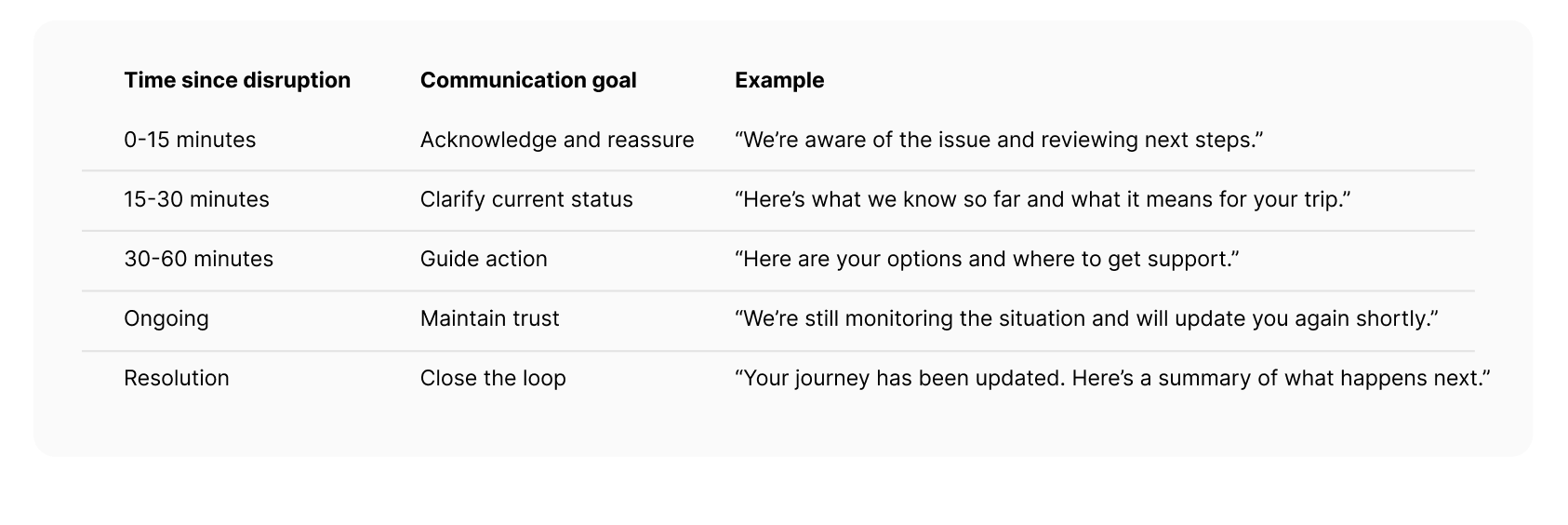
This kind of structure keeps the communication journey organised and predictable.
Why the rule builds loyalty, not just control
It is easy to think of disruption messaging as a form of damage limitation. But done well, it can do more than that.
It can build loyalty.
Customers remember brands that communicate well under pressure. When something goes wrong, they are not just judging the problem. They are judging the response.
A fast, honest, and helpful message says:
- we see the problem
- we respect your time
- we are managing this
- we will keep you informed
That creates confidence. And confidence is the foundation of trust.
In fact, some of the strongest customer relationships are built not during perfect journeys, but during imperfect ones that were handled well.
The 15-Minute Rule in one sentence
If a disruption affects your customer, do not wait for perfect information. Communicate within 15 minutes, acknowledge the issue, and tell them what comes next.
That is the rule.
It is simple, practical, and powerful because it matches what customers need most in stressful moments: clarity, visibility, and reassurance.
In travel and hospitality, disruption is inevitable. But confusion, silence, and poor communication do not have to be. Brands that respond quickly, clearly, and consistently can reduce stress, protect customer confidence, and turn difficult moments into proof of good service.
The first message may not solve the disruption. But it can steady the experience.
And in moments where customers feel most uncertain, that can make all the difference.