.svg)


In travel and hospitality, not every unhappy guest starts with a bad stay. Sometimes the problem begins before the trip even happens.
A guest books with excitement, only for life to get in the way. Illness, family emergencies, transport disruption, work changes, or unexpected personal events can all stop a trip before it starts. When that happens, the guest is often stressed and worried about losing money. Even if the business is technically following its booking terms, the emotional experience can still feel negative.
That is where the review recovery toolkit becomes so important.
When a guest cannot travel, the situation turns into a brand moment. Handled badly, it can lead to angry emails, poor reviews, chargebacks, lost future bookings, and damage to trust. Handled well, it can turn a disappointed customer into a loyal one who remembers the business for its empathy, fairness, and professionalism.
This is the heart of review recovery: not just preventing negative feedback, but creating a response that protects the relationship.
Let’s look at what travel and hospitality brands should do when a guest cannot travel, and how to turn a potentially negative experience into long-term loyalty.
Why pre-travel problems create strong emotional reactions
When a guest misses a trip, they’re losing money and often an important life moment.
That trip may have been:
- a family holiday
- a honeymoon
- a business trip
- a birthday getaway
- a long-awaited reunion
- a once-a-year break
So even if the issue is outside the business’s control, the guest may still connect their frustration to the brand. In their mind, the business is the place where the disappointment lands.
That is why brands need to think beyond policy alone.
Yes, terms and conditions matter. Clear cancellation rules matter. Operational consistency matters. But when a guest cannot travel, what matters just as much is how the business responds in the moment.
A cold or rigid response can make the situation feel worse. A thoughtful one can reduce anger, preserve trust, and even improve the guest’s long-term view of the brand.
The real goal of review recovery
Many brands think review recovery means stopping a bad review from being posted.
That is too narrow.
The real goal is to:
- reduce emotional frustration
- show the guest they are being treated fairly
- offer practical next steps
- protect the brand relationship
- create a reason to return in future
A guest who feels heard and helped is far less likely to become publicly negative. And even when they are disappointed by the outcome, a respectful process can still leave a strong impression.
Step 1: Respond fast and with empathy
When a guest says they cannot travel, speed matters.
The longer they wait for a response, the more their stress grows. That silence can quickly turn uncertainty into anger. Even if the final outcome is not perfect, a fast and human reply can lower the temperature straight away.
The first response should do three things:
- acknowledge the situation
- show empathy
- explain the next step clearly
For example, a strong message does not need to be dramatic. It just needs to sound human:
“We’re sorry to hear your plans have changed. We understand these situations can be stressful. Let us walk you through the options available for your booking.”
That kind of language matters. It tells the guest they are not dealing with a wall. They are dealing with a brand that recognises the problem.
This does not mean promising something the business cannot deliver. It means showing care before discussing the mechanics.
Step 2: Make the options easy to understand
One of the biggest reasons guests become upset is confusion.
If a guest cannot travel, they need immediate clarity on questions like:
- Can I cancel?
- Can I rebook?
- Can I get a refund?
- Can I claim through a protection product?
- Can I move the dates?
- What happens next?
If the answer is buried in policy language, spread across multiple emails, or explained differently by different agents, frustration rises fast.
The best brands simplify the moment.
They present the guest with a clear set of options in plain language. For example:
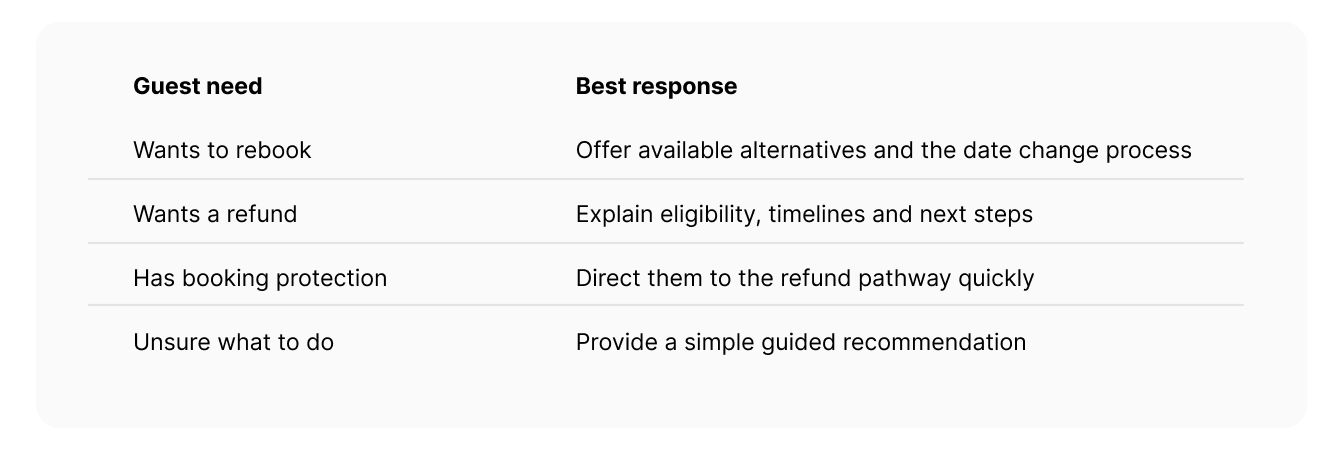
Clarity reduces panic. It also makes the brand appear more organised and trustworthy.
Step 3: Train teams to focus on resolution, not resistance
A guest who cannot travel is already dealing with a problem. If the service team sounds defensive, robotic, or overly script-driven, the interaction can quickly go downhill.
Many negative reviews stem from a sense of being blocked, not just from the policy itself.
That is why customer-facing teams need a review recovery mindset. They should not ask, “How do I close this case?” They should ask, “How do I help this guest feel guided through the situation?”
This means:
- listening before replying
- avoiding blunt policy-only language
- offering the best available route, not just saying no
- explaining why an option is or is not possible
- using calm, respectful wording throughout
Even when the answer is limited, the guest should feel that the team tried to help.
That effort is often what separates a one-star reaction from a more understanding one.
Step 4: Offer a fair alternative when a full refund is not possible
Not every booking can be refunded. But that does not mean the business has no recovery tools.
If a full refund is not available, consider alternatives that still preserve goodwill:
- date changes
- booking credit
- partial refund where appropriate
- waiver of change fees
- loyalty credit for future travel
- value-add on a rebooked stay or trip
These options can soften the disappointment without breaking the commercial model.
The key is to position the alternative well. A guest should not feel like they are being pushed into something unwanted. They should feel like the business is trying to find the fairest path within the rules.
For example, “While this booking is non-refundable, we can offer a credit for future travel” usually lands better when paired with empathy and context than when presented as a hard line.
The alternative does not erase the disappointment. But it can reduce the sense of loss and give the guest a reason to stay connected.
Step 5: Use protection products and flexible solutions as recovery enablers
This is where protection and flexibility tools become especially valuable.
If a guest added a protection product at booking, the recovery path becomes much smoother. Instead of a dead end, there is a route to reimbursement or support when life interrupts travel plans.
That matters not only to the guest but to the brand as well.
When a guest has access to a clear claims or refund process for events, the business is no longer forced to carry the full emotional burden of saying no. The conversation changes from denial to guidance.
Instead of:
“Your booking is non-refundable.”
The message becomes:
“Your booking includes protection for certain unexpected events. Here is how to start the process.”
That is a very different experience.
It helps the guest feel protected and helps the brand avoid the kind of frustration that often leads to negative reviews. In this way, protection products are more than commercial add-ons. They’re part of a strong recovery toolkit.
Step 6: Personalise the response where it counts
Guests can tell when a message is copied and pasted.
Some standardisation is necessary, especially at scale, but review recovery works best when there is at least a touch of personalisation. That might include:
- using the guest’s name
- referring to the trip or stay
- acknowledging the reason for cancellation where appropriate
- tailoring the offered options to their situation
This does not require a long custom email every time. It simply means showing that the business sees the guest as a person, not just a booking reference.
That small shift can make a big difference in tone.
A personalised recovery response helps the guest feel respected. And respect is often what keeps disappointment from becoming resentment.
Step 7: Follow up after the immediate issue is resolved
Many brands stop communicating once the case is closed.
That is a missed opportunity.
A thoughtful follow-up can turn a transactional fix into a loyalty-building moment. For example:
- checking that the guest received their refund or credit
- confirming that the claim or refund journey was completed
- offering help with rebooking
- inviting them back with a future-use incentive
- thanking them for their understanding
This is especially powerful if the guest had a frustrating interruption through no fault of their own. A follow-up message shows that the brand still cares even after the administrative work is done.
That is where loyalty often starts. Not from perfection, but from how the brand behaves after a problem.
Step 8: Invite feedback privately before it becomes public
If a guest has experienced a disruption, it is smart to set up a private feedback channel before they head straight to public review platforms.
This does not mean trying to silence criticism. It means giving the guest an easier, more direct path to express how they feel and be heard.
A simple post-case message can help:
“We’d love to hear how we handled your experience so we can improve.”
That kind of invitation can surface issues early, provide valuable learning, and reduce the chance that the first public review appears without context.
It also gives the business a chance to spot patterns:
- Was the policy clear enough?
- Did the response take too long?
- Did the guest understand their options?
- Was the tone too rigid?
- Did the recovery action feel fair?
Good review recovery is not just reactive. It improves the whole operation over time.
Step 9: Turn the experience into a loyalty opportunity
This is where the real upside lies.
A guest who cannot travel may still become a repeat customer if the business handles the situation with empathy and intelligence. In fact, some of the most loyal customers are people who experienced a problem but felt the brand stood by them.
Here are some ways to turn a negative into loyalty:
- offer a welcome-back incentive for future booking
- add a small upgrade or perk to the rebooked stay
- provide priority support on the next interaction
- create a smoother rebooking path
- acknowledge their previous inconvenience when they return
These gestures do not need to be expensive. They need to feel thoughtful.
Loyalty is not always built during the best moments. Often, it is built during the difficult ones.
A practical review recovery toolkit for hospitality teams
To make this easy to apply, here is a practical toolkit brands can use when a guest cannot travel:
1. Empathy-first response template
Start with understanding, not policy.
2. Clear option framework
Show cancel, rebook, refund, credit, and protection pathways simply.
3. Escalation rules
Make sure complex or sensitive cases move quickly to empowered staff.
4. Flexible goodwill levers
Use credits, waived fees, or future-value offers where appropriate.
5. Protection pathway
If the booking includes protection, direct the guest immediately and clearly.
6. Follow-up communication
Check resolution, offer support, and keep the relationship warm.
7. Private feedback request
Learn from the case before frustration spills into public channels.
8. Loyalty recovery offer
Give the guest a reason to come back.
This toolkit works best when it is built into daily operations, not saved only for major complaints.
What causes the worst reviews in these moments?
If brands want to improve, they need to know what usually triggers the harshest reviews when a guest cannot travel.
Common causes include:
- slow replies
- cold or dismissive tone
- confusing terms language
- inconsistent answers from staff
- no visible attempt to help
- unclear protection or refund process
- being bounced between teams
- lack of follow-up after resolution
Notice that many of these are not about the outcome alone. They are about the experience surrounding the outcome.
That is encouraging, because it means brands can improve a lot without changing every commercial policy. Better communication and smarter recovery design can go a long way.
Why this matters more than ever
Today’s guests are quick to share their experiences publicly. A poor no-travel experience can show up in:
- Google reviews
- TripAdvisor posts
- social media comments
- direct complaints
- support forum discussions
And because pre-trip disappointment often feels personal, these reviews can be especially emotional.
That makes recovery a serious brand issue, not just a service issue.
The good news is that hospitality brands are not powerless here. With the right toolkit, they can reduce friction, improve perception, and create better outcomes even when a stay never happens.
That is why the review recovery toolkit matters.
It helps hospitality brands move from simply enforcing policy to protecting relationships. And in a market where customer trust is hard won and easily lost, that shift can make all the difference.
Because sometimes the strongest proof of great service is not what happens when everything goes right. It is what happens when a guest cannot travel at all.