


.svg)


Travel brands have learned a simple truth: the right add-on at the wrong moment often goes unsold.
That is why the modern add-on stack is no longer just a list of extra products bolted onto checkout. It is a timed offer strategy built around the traveller journey. What a customer wants when booking is different from what they want on departure day, and different again from what they care about after the trip. When brands match the product to the moment, conversion rates improve, customer value rises, and the experience feels helpful rather than pushy.
For airlines, OTAs, hotels, and travel platforms, this creates a clear framework. Some add-ons work best pre-trip, when customers are planning and comparing. Others perform better at-trip, when convenience and urgency matter most. A smaller but growing set of offers belongs post-trip, when brands can extend the relationship and create future revenue.
Let’s break down the modern add-on stack across the three key stages of the journey, including products like eSIM, baggage delay compensation, flight delay compensation, carbon offsetting options, and lounge access, and explain why timing matters so much.
What is the modern add-on stack?
The modern add-on stack is the set of ancillary products offered around a booking in a way that feels relevant and timely.
It is “modern” because it moves beyond the old approach of showing every optional extra at once. Instead, it uses context:
- What is the traveller booking?
- Where are they in the journey?
- What problem are they trying to solve right now?
- What level of urgency do they feel?
That matters because travellers do not think in product categories. They think in needs.
A customer booking an international trip may think, “Will I have data when I land?” That points to an eSIM. A traveller flying with checked luggage may worry, “What if my bag is late?” That points to baggage delay compensation. A frequent flyer with a long layover may think, “I just want somewhere quiet to sit.” That points to lounge access.
The best add-on strategy meets those needs at the right time.
Why timing matters more than ever
Timing matters because travel buying is emotional and highly situational.
At booking, the customer is focused on making a decision. They are weighing price and risk. This is the moment for add-ons that support planning and trip setup.
Closer to departure, the customer shifts into execution mode. They care less about abstract value and more about convenience and real-time problem solving.
After the trip, the traveller is no longer planning that journey. But they may still be open to future value, loyalty offers, feedback-led upsells, or services linked to what they just experienced.
A poorly timed offer creates friction. A well-timed one feels smart.
That is why a modern add-on stack should be mapped across three stages:
- Pre-trip: before departure, often at booking or in the lead-up to travel
- At-trip: during the live journey, especially around the airport and transit moments
- Post-trip: after return, when re-engagement and retention matter
Pre-trip: Add-ons that build confidence and preparedness
Pre-trip is the strongest moment for add-ons that help travellers prepare, reduce risk, or personalise the trip before it starts.
These products are usually best sold at checkout, in the booking path, or in follow-up messages between booking and departure.
1. eSIMs
An eSIM is a strong pre-trip product because it solves a very clear traveller problem: staying connected on arrival.
Most travellers do not want to land in a new country and start hunting for Wi-Fi or a local SIM card. Buying an eSIM before departure feels efficient and reassuring. It is especially compelling for digital-first travellers and people visiting multiple countries.
Why pre-trip works:
- The customer is already thinking about the destination
- Connectivity is part of trip planning
- The product is easy to understand and easy to deliver digitally
Why timing matters:
If you offer eSIM too late, the traveller may have already solved the problem another way. At booking or in a pre-departure email, the value feels obvious.
2. Baggage Delay Compensation
Baggage delay compensation is also a natural pre-trip offer, especially for air travel. It addresses a known risk and provides peace of mind before the journey begins.
This type of add-on works because the customer can picture the disruption. If a bag is delayed, the inconvenience is immediate. Offering compensation helps the traveller feel protected.
Why pre-trip works:
- Risk protection is easier to buy before travel starts
- Customers are more open to contingency planning at booking
- It pairs well with flights involving connections or longer-haul travel
Why timing matters:
At booking, the customer is still making choices about what level of reassurance they want. Once they are already at the airport, that mental window is smaller.
3. Carbon Offsetting
Carbon-related add-ons, whether carbon offsetting or broader sustainability contributions, usually belong in the pre-trip stage as well.
These are values-based purchases. They work best when the customer considers the trip's overall impact and wants to make a positive choice as part of planning.
Why pre-trip works:
- It fits naturally into the booking decision
- It connects to the trip as a whole
- It gives the traveller a chance to align travel with personal values
Why timing matters:
Carbon is rarely an impulse purchase made during a stressful airport moment. It performs better when presented clearly and with simple language at booking or shortly after.
4. Seat upgrades, fare protection and flexibility products
These are classic pre-trip add-ons because they shape the journey before it happens. The traveller is still setting preferences, evaluating comfort, and thinking about “what if” scenarios.
This is also where protection products are especially powerful. A traveller who wants flexibility but does not want to pay for a fully flexible fare may be interested in a lighter-touch protection solution that offers reassurance.
At-trip: Add-ons that solve live travel needs
At-trip is where urgency rises. The customer is travelling now, not just planning. This is the best moment for products that offer convenience, speed, comfort, and immediate utility.
The at-trip stage usually includes:
- check-in
- departure-day communications
- airport dwell time
- delays and disruptions
- destination arrival moments
1. Lounge access
Lounge access is one of the clearest at-trip add-ons because its value becomes strongest when the airport experience becomes real.
A long layover, a delayed departure, crowded terminals, or business travel fatigue can suddenly make lounge access feel much more appealing than it did at booking.
Why at-trip works:
- Need is immediate and emotional
- The customer understands the pain point in real time
- The product feels like a live upgrade, not an abstract extra
Why timing matters:
Selling lounge access months before departure may work for some premium travellers, but many customers only feel the value when they are close to travel or already at the airport.
2. Last-minute eSIM prompting
While eSIM is strongest pre-trip, it can also work at-trip in certain moments, especially on arrival or just before departure.
For example, if a traveller has not yet bought data access, a well-timed message before boarding or after landing can still convert. The key is that the message must feel like a solution, not a repeat offer.
Why at-trip can still work:
- The need becomes urgent
- Delivery is instant
- The customer can activate quickly
Why timing matters:
This is where journey data helps. If the customer already bought an eSIM, do not show it again. If they did not, the at-trip moment can act as a final helpful nudge.
3. Fast-track, transfers and day-of-travel convenience products
This is the broader at-trip category. Travellers are highly responsive to offers that remove hassle when they are already in motion.
These can include:
- fast-track security
- airport transfers
- premium support services
- disruption assistance
- local connectivity tools
These products work because the customer is no longer imagining inconvenience. They are living it.
4. Real-time protection and disruption support
Some protection-related products become especially relevant during live disruption moments. While most protection is best sold pre-trip, at-trip messaging can support claims guidance, assistance pathways, or related convenience offers.
The lesson here is simple: do not just sell protection before a trip. Use the live journey to reinforce value and support the traveller when the need arises.
Post-trip: Add-ons that extend the relationship
Post-trip is often the most overlooked stage of the stack.
Many travel brands treat the trip as finished once the traveller gets home. But post-trip is a valuable moment for re-engagement, future conversion, and loyalty-building.
The goal is not to force one more sale. It is to use trip completion as a springboard into the next interaction.
1. Loyalty and Future-trip Offers
The strongest post-trip offers are usually tied to future travel. For example:
- discount on the next booking
- premium membership trial
- lounge subscription
- preferred travel add-on bundle for a future trip
Why post-trip works:
- The brand relationship is still fresh
- Customer satisfaction is easiest to measure here
- Positive trip memories can support repeat purchase
2. Sustainability Follow-up
If a traveller selected a carbon option pre-trip, post-trip is a good time to show the impact story. This turns a one-time checkbox into a more meaningful brand moment.
That can strengthen trust and increase the chance that the traveller makes a similar choice next time.
3. Service Recovery and Retention Offers
If the trip involved disruption, baggage issues, or poor service, the post-trip stage becomes critical. This is the time for customer care, make-good offers, and carefully chosen future-trip incentives.
Timing matters here because the traveller is judging the brand not only on what went wrong, but on how it responded after the fact.
Why certain products belong in certain moments
To keep it simple, here is how the four example add-ons usually fit:
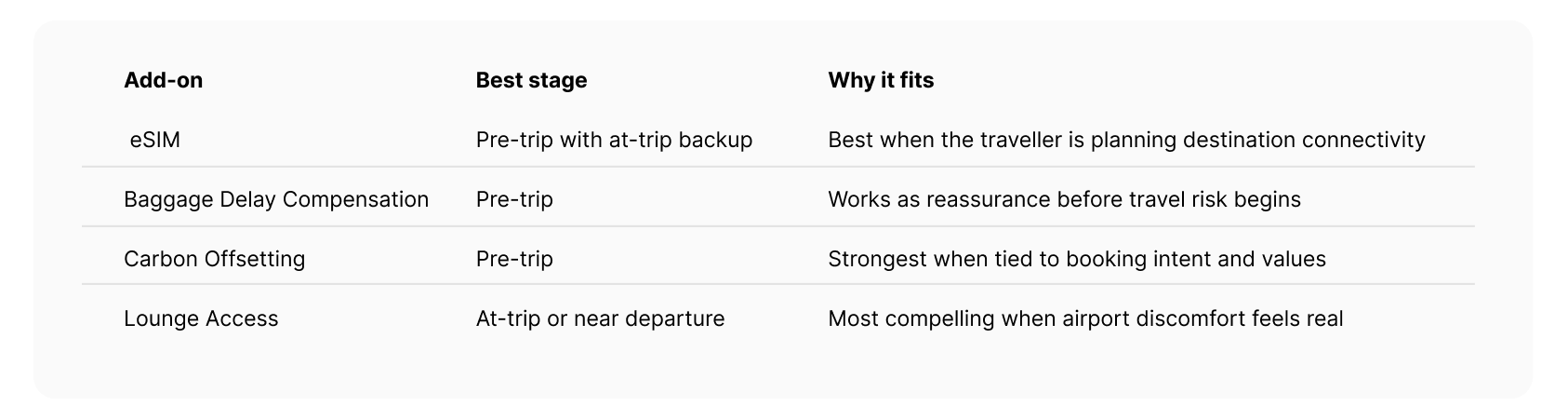
This does not mean each product belongs in only one place. It means each has a primary conversion window.
That is the real point of the modern add-on stack: not just what to sell, but when to sell it.
How to Build a Smarter Add-on Journey
Travel brands do not need dozens of extras. They need a smaller set of well-timed, relevant offers.
A strong add-on journey usually follows these principles:
Keep the checkout focused
Do not overload the booking path with every possible product. Start with the most relevant pre-trip offers.
Use journey signals
Destination, trip length, baggage selection, route type, and departure time can all improve offer timing.
Match the message to the moment
A traveller at checkout needs confidence. A traveller in the airport needs convenience. A traveller, after returning, needs a reason to come back.
Avoid duplication
If a customer has already bought an add-on, move on. Relevance matters more than repetition.
Think in needs, not products
Do not ask, “How do we sell lounge access?” Ask, “When does comfort become urgent?” That leads to better timing.
The Revenue Case for Better Timing
Timing is not just a customer experience issue. It is a revenue strategy.
When add-ons appear in the right moment:
- conversion rates can improve
- ancillary revenue becomes more efficient
- customer trust rises
- the booking journey feels less cluttered
- the brand appears more helpful and intelligent
Poor timing does the opposite. It lowers engagement, makes offers feel noisy, and trains customers to ignore add-ons altogether.
A modern stack is not about selling more things. It is about creating better-fit offers across the full travel lifecycle.
The future of the add-on stack
The next phase of travel ancillary growth will likely come from orchestration, not volume.
Winning brands will be the ones that understand:
- which products matter most to which traveller
- when demand for those products peaks
- how to present offers simply and clearly
- how to connect pre-trip, at-trip, and post-trip into one continuous journey
The future stack will be more dynamic, more personalised, and more event-driven. But the core idea will stay the same: timing shapes value.
An eSIM offered before an international trip feels useful. Lounge access offered during a delay feels timely. A future-trip offer sent after a great journey feels natural. The product matters, but the moment often matters more.
The modern add-on stack is really about relevance across time.
Pre-trip is for preparation, reassurance, and setup. At-trip is for convenience, comfort, and solving life's needs. Post-trip is for retention, loyalty, and extending value beyond the journey itself.
That is why timing matters so much. Travellers do not buy add-ons in theory. They buy them in context.
For travel brands, the opportunity is clear: stop treating ancillaries like a single sales layer and start treating them like a journey-based strategy.
When the right product meets the right customer at the right time, everybody wins.